Google Website Translator Gadget

Total Pageviews

Search This Blog

Showing posts sorted by date for query Leslie Schwartz. Sort by relevance Show all posts

19 October 2026

Ever Thought Your Life Would Make a Great Book???

If you've ever wanted to tell your life story in book form, I can help. I've done several projects for people who've lived extraordinary lives and wanted to preserve their stories for future generations. If you don't tell your story, future generations may never know it--think of the wisdom and life lessons you can pass on to children, grandchildren and even great grandchildren--if you don't tell them, how will they ever know? We can do books just for your family or even books you can sell or use for professional purposes. I'm an expert at research and do extensive personal interviews with you to weave the story. Projects can take a few months to complete. I love people and their stories, and I feel a strong commitment to preserving history for future generations.

I want to help you, so email me at marcbonagura@gmail.com


Marc David Bonagura (MA Creative Writing, University of Georgia) is a Professor of English at Brookdale Community College in Lincroft, New Jersey and the co-author, with Leslie Schwartz, of Surviving the Hell of Auschwitz and Dachau: A Teenage Struggle Toward Freedom From Hatred (Lit Verlag Press, 2013). Professor Bonagura has completed hundreds of hours of interviews with World War II veterans for the Veterans History Project and Library of Congress. His work is also featured in several Holocaust museums, and his research on the World War II era has been featured in documentaries and dramatic films as well as major television series.  


09 May 2021

LESLIE SCHWARTZ HOLOCAUST SURVIVOR (1930-2020) BIBLIOGRAPHY

I find it remarkable just how much media attention Leslie Schwartz achieved in a span of just a few years, and we never had an agent or public relations team, only word of mouth. 

Our work went out to millions of people all over the world. 

I hope to keep Leslie's work and life's message alive for many years to come and to build upon his efforts to educate future generations of students. 

This is an incomplete list; please send me links and I will add them and update as they come in.

-Marc David Bonagura


BOOKS


Surviving the Hell of Auschwitz and Dachau: A Teenage Struggle Toward Freedom from Hatred

Leslie Schwartz (1930), Marc David Bonagura (1961)

2013 Lit Verlag

ISBN 978-3-643-90368


Durch die Holle von Auschwitz und Dachau

Ein Junge erkampft sein Uberleben

Leslie Schwartz (1930)

2010 Lit Verlag

ISBN 978-3-643-10821-0


At overleve helvede: en af de sidste overlevende fra Auschwitz

Leslie Schwartz (1930), Karen Thisted (1946)

2007 Politikens

ISBN 978-8-756-78073-5


 BLOG POSTS

Enter "Leslie Schwartz" in the search box and list sorted by "date" and  all my blog posts will be listed.

Here is a link: http://marcbonagura.blogspot.com/search?q=Schwartz&max-results=20&by-date=true

https://blogs.bgsu.edu/history/2015/01/an-evening-with-holocaust-survivor-leslie-schwartz-hosted-by-bgsu-history-department-february-5th/ 


UNITED STATES HOLOCAUST MEMORIAL MUSEUM

https://collections.ushmm.org/search/catalog/irn50293 


WIKI PAGE

https://second.wiki/wiki/leslie_schwartz


NEWSPAPER ARTICLES

https://bcccurrent.com/676/features/leslie-schwartz/

https://www.sun-sentinel.com/florida-jewish-journal/news/palm/fl-jjps-leslieschwartz-0415-20150413-story.html

https://www.nytimes.com/2013/12/28/world/europe/holocaust-history-as-told-by-a-survivor.html

https://www.sun-sentinel.com/florida-jewish-journal/news/palm/fl-jjps-leslieschwartz-0106-20160104-story.html

https://www.hattiesburgamerican.com/story/news/education/usm/2016/02/15/holocaust-survivor-speak-documentary-screening/80422828/

https://www.merkur.de/lokales/ebersberg/poing-ort29300/poing-holocaust-ueberlebender-leslie-schwartz-ist-tot-13780168.html 

https://www.sueddeutsche.de/muenchen/ebersberg/nachruf-trauer-um-leslie-schwartz-1.4915571

https://wiedertaeufer.ms/kaempfer-gegen-das-vergessen/

https://uaatwork.arizona.edu/uannounce/talk-and-film-showing-holocaust-survivor-leslie-schwartz 

https://www.usm.edu/news/2016/release/holocaust-survivor-speak-documentary-screening-feb-23.php

https://www.bgfalconmedia.com/campus/holocaust-survivor-speaks-about-time-at-concentration-camp-auschwitz/article_202a5d54-adb6-11e4-b652-f78e6297789d.html

https://www.studentprintz.com/three-times-before-age-16-i-should-have-died-holocaust-survivor-shares-story-at-usm/ 

https://www.wpbf.com/article/holocaust-survivor-finds-peace-speaking-to-teens/1311771

https://www.wdam.com/story/31308317/holocaust-survivor-attends-screening-of-film-at-usm-on-nazi-atrocities/

https://thevarsity.ca/2015/11/02/holocaust-survivor-comes-to-victoria-college/


AUDIO RECORDINGS

https://www.wbur.org/hereandnow/2014/02/28/holocaust-survivor-students 


VIDEOS

https://youtu.be/efdB4Kp0fU8 

https://www.pbs.org/video/conversations-leslie-schwartz/


FILMS

The Muhldorf Train of Death

2012

Beatrice Sonhuter

https://www.beatrice-sonhueter.de/the-muhldorf-train-of-death/


The Samuel Project

2018

Directed by Marc Fusco

https://vimeo.com/223920819


19 May 2020

HONORING LESLIE (LASZLO) SCHWARTZ (1930-2020)

"Misfortune is virtue's opportunity." 
Seneca

"Forgiveness is a mystical act, not a reasonable one."
Carolyn Myss

LESLIE SCHWARTZ died in Florida on May 12, 2020 at the age of 90. While this news wasn't wholly unexpected, I thought he would somehow bounce back. Leslie was always superhuman to me, resilience personified; through all the normal misfortunes, diseases and bad breaks we all endure, to the unthinkable horrors he lived through in Auschwitz and Dachau, Leslie could survive, even thrive, in almost any situation. He always told me, "it's not what you achieve that matters most; it's what you've overcome." I figured in a few more months he'd be back on his feet, out of the hospital and doing what he loved best, talking with students, educating them about the Shoah--speaking with all his heart, mind, body and soul, and the unbelievable strength he always seemed to muster, again and again, while traveling the world doing this holy work.


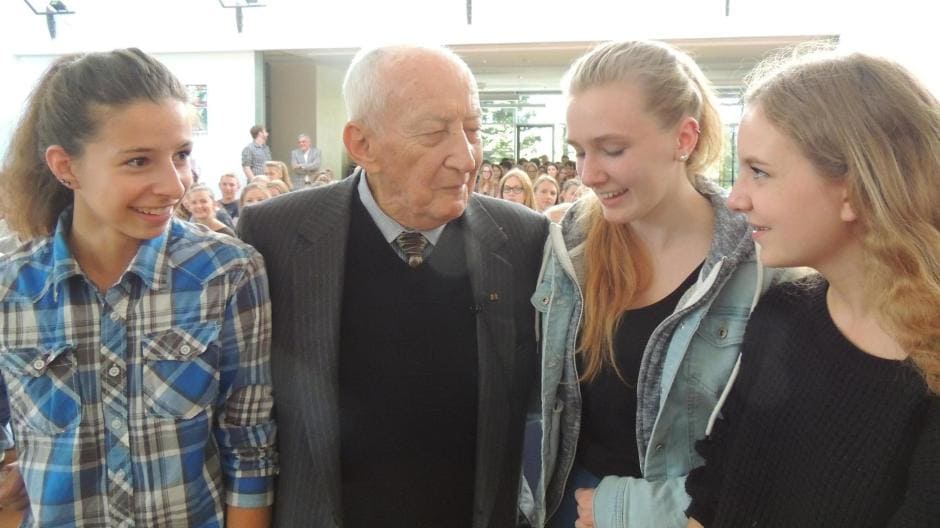
with German students
"This is where my healing started, by trusting and believing in the new generation of Germans."

HE SPOKE WITH TENS OF THOUSANDS OF STUDENTS, from the United States to Europe, and especially in Germany, his adopted country--and while the irony of a Holocaust survivor finding a home in Germany wasn't lost on a lot of people, his reconnecting to the nation that murdered his immediate family was essential to his own healing journey, for it was the descendants of the people who had orchestrated the war and inflicted genocide upon untold millions he sought most to reach, so a better future for them and for the world might someday become a reality. He told me many times the older Germans, those who had been alive during the war, weren't so eager to embrace their history. Once when acting as an impromptu "tour guide" at Dachau, he met an elderly man who had been an SS Guard there. Leslie casually told him, "I was once a prisoner here". The man replied, while sizing up Leslie, "I guess I didn't do my job."

HE HELD MANY DREAMS close to his heart his entire life; in addition to being reunited with his mother, after being separated from her when he was just fourteen years old in the lines at Auschwitz, he wished for the human race to learn from the dark times and unimaginable horrors he endured during World War II. That we not repeat the Holocaust. That we help to heal each other--without regard to borders, race, religion or personal biases--anything that separates us from one another had to go, for in his wisdom, peace and justice without healing were impossible.

IN THE PAST DECADE OR SO, Leslie Schwartz and I  wrote a book together, presented lectures and facilitated discussions at many different venues, large and small, from elementary schools to college campuses to the United Nations--corresponding with world leaders and children alike, our work was recognized by major media all over the world from The New York Times, NPR, and Fox News in the United States to Süddeutsche Zeitung and Bavarian Television in Germany, and so many other outlets I can't even remember. A frequent speaker at international events of remembrance, he was given many honors and awards, even the Knight's Cross for his service to Germany, but the impact Leslie had on my life is still hard to put into words. He was the fourth person who emerged from World War II to educate me personally, so that I could understand how something that ended sixteen years before I was even born was still affecting me in profound ways. Today they call it inter-generational trauma or epigenetics, but all I knew is something wasn't right my entire life. How many other millions and millions of people, the children of Holocaust survivors or combat veterans or anyone who has experienced severe trauma, have felt this same unnamable void? My father, a US Marine who fought in the Pacific, brought home severe, although often invisible disabilities I couldn't make any sense of as a child, yet these disabilities had incredibly detrimental, very real effects on my family; then Bob Worthington, another Marine from the Pacific, who is largely responsible for my career path, literally forcing me to tell his story--he made me become a writer--came into my life, and I began interviewing other World War II veterans from that point on.  Although Bob's life was completely destroyed by the war, and his disabilities wrecked havoc in every aspect of his life, he always sought healing. He wanted to change his brain entirely, to see the world in a new way, and he prepared me for that mindset.  Then my friend Jimmy Mirikitani, world renown artist who spent World War II in a Japanese internment camp in California--that experience altering the trajectory of Jimmy's life to the point where he wound up homeless on 6th Avenue in New York, well into his 70s--yet another person I met who was seeking his voice and some kind of healing experience--that the world not forget what he went through. And finally Leslie came along. Leslie was a child during the war. Leslie had the opportunity to heal simply because he had more time than the others. I helped Leslie find his voice as I've done for my writing students throughout my entire career. I helped him to communicate his deepest feelings to others, and we shared a simpatico that was instantaneous. I so enjoyed our conversations, sometimes several times a day, for many years. We shared the joys of this newfound recognition. People sought him out for appearances. Suddenly he mattered to a whole new generation, and he loved the connection with those younger students--they laughed with him and cried with him and hugged him like they would their grandfathers. For the German students, the war was a distant memory to their parents and grandparents, but the echoes of the war still affected them. With KZ camps literally all over Germany, they walked through the shadows of their ancestors' crimes everywhere they went, and students and teachers there resonated with Leslie's quiet message; he'd first simply inform them of what went on--to speak for all those whose voices were forever silenced-- and then he'd allow the students into his emotional aura, healing together, no longer alone, to face the impossible task of coming to terms with darkest parts of the human psyche the world has ever seen to create something life affirming out of that spiritual poison.

1972 with Agnes Reisch

Barbara Huber and spouse

WHAT LESLIE FEARED MOST was that the stories of those who had been murdered might one day be erased from history--he also longed to find his mother again; every minute while in the camps he wished to be reunited with her, and he also feared becoming just like the Nazi's, like an animal that preys on other, vulnerable or weakened animals. He feared hatred like we fear a contagious and deadly virus and desperately wished not to be infected. And, strangely, he also wanted to understand everything--even the reasons the Nazi's had created this hell on earth. He had an insatiable curiosity about life, and he wanted to understand his persecutors. But the real reason he wasn't able to hate was because several German civilians helped him stay alive. Martin Fuss, the railroad worker  brought him liverwurst sandwiches, and Barbara Huber and Agnes Reisch were farmers' wives who nourished him with bread and love directly in the face of SS Guards. Agnes called him "my son." Her biological son was in a prison camp in Russia. All she saw was a scared little boy who needed a mother--she once asked him, "how can you be a political prisoner?" The guards once confronted Agnes Reisch when she was caught bringing bread to Leslie at Dachau; they told her, "if you keep this up, we'll put you in here." She replied, "I don't care; I'm old." If these good people were also German, how could he hate all Germans? Leslie kept in touch with Reisch and Fuss for decades after the war, even visiting Reisch, bringing her a loaf of bread in 1972 in a famous photograph that made the New York newspapers. She fell on hard times after the war as her husband was murdered by concentration camp survivors in Dachau upon their liberation. He was just riding his bike home one night and was in the wrong place at the wrong time. Leslie wound up sending her care packages for years after the war. He was reunited with Huber in a sense when he discovered her identity a few years ago--she had long since passed away, but he never forgot her kindness. One afternoon in April 1945 she fed Leslie and a few of his fellow prisoners delicious bread with creamy butter and, as Leslie would say many times, the best milk he ever tasted after they had escaped (briefly) from the infamous Muhldorf train of death, only to be captured by Hitler youth later that same day--a woman invites you, a starving, emaciated concentration camp prisoner into her kitchen and gives you milk, and you remember those few hours for the rest of your life as one simple act of kindness alters forever the future. You can't tell Leslie's story without mentioning these people. He never would have reached out to the German people with so much love had those brief moments of peace in the middle of war not occurred. And how many lives did he later affect in Germany because of his openness and willingness to connect with people? And so the cycle of hatred is forever broken. Who needs nuclear bombs when we have love?


Max and Leslie at Tutzing Ceremony


MAX MANNHEIMER WAS THE KEY TO EVERYTHING. Max and Leslie had known each other in the camps. Max was older and spoke German, so he was a great asset to Leslie, who at that point, spring 1945, saw his chances for survival dwindle with every passing day--Max encouraged Leslie to keep fighting--that somehow he could make it through slave labor, disease, starvation and torture. That had a friendship of sorts that flowered sixty years or so later. Max Mannheimer spent his life educating German students, helping them to heal from hatred's poison, loving fearlessly the nation that tried to murder him--from the first days after the war, he stayed in Germany and began working for peace and promoting education, spreading hope that change was possible and a better future could emerge if people were willing to face things directly and, first, simply listen to each other. Max and Leslie were not normal people, and when Leslie saw first hand what Max did, especially speaking to German students, Leslie thought to himself, I want to do that as well. And so he did, beginning around 2008 and for many more years to come, and that's when everything began to change for Leslie. He even had an apartment with his spouse in Munster and looked forward to traveling to Germany every summer. Finding his voice and connecting with students and teachers who realized what an incredible blessing it was to have Leslie there, alive, standing right in front of them, willing to answer any question and help them understand what happened in their own backyards and all over Germany--this experience was something rare and Leslie was a treasure to them. He felt their love and appreciation very powerfully, and the experience genuinely gave his life new vitality.


Meeting Chancellor Merkel

THE MOST IMPORTANT MESSAGE he brought students and to anyone struggling with impossibly difficult situations is that hatred is useless and damaging--even if justified--being a victim is a powerless and lonely existence compared with that of a survivor--even better--a survivor who uses all experiences as a portal toward wholeness, knowing we all need each other to heal, and the world is a very small place. Turning enemies into allies is no small feat, yet some of the most important healing work happens when you forgive and bring your adversaries into the healing process with you, requiring truth telling and active listening, and ultimately action, for forgiveness is an active process that demands a lot of hard work--and time and patience--and you still need miracles to happen after all this, but they will come, though not always according to our schedules. These miracles took more than sixty years in Leslie's case.

IN THE END Leslie Schwartz understood our sacred task is not to pass along shared trauma but to create a better future and to hand down to younger generations tools for healing and reasons to hope, and Leslie gave us all plenty of hope. The best way we can honor Leslie Schwartz is simply to keep his work alive--resolve conflict without violence--and always to remember him. If you were lucky enough to spend any time with him, you were made better for the experiences. You couldn't look at anything the same way afterwards--your first move, no longer to react, with fight or flight, but to stay and face things, no matter how difficult--to reach for compassion, to find kindness and to value honesty and storytelling as important though often overlooked conflict resolution methods. You find hope, no matter what mountains lay ahead of you in your journey. The simple act of one human speaking to another--listening to each other without judgement--allowing for all the inevitable, uncomfortable silence to be filled with something new--unimaginable miracles--things you couldn't dream up in any parallel universe. And these miracles happened frequently for Leslie, like the time he met Chancellor Merkel--seventy years after the small boy who was supposed to have been worked to death by the Nazi's--greeted and honored by the German Chancellor--that kind of experience far too improbable for any Hollywood screenplay. Even Leslie's famous cousin, American screen legend, Tony Curtis, never made a film that far fetched. I'll never forget you, Leslie, and all I can do now is say "thank you for sharing so much of yourself with me and with the world." Leslie never liked to say good bye, so I won't either.


At Bowling Green University, April 2013
Some links to past stories:

Leslie's speech on the 70th Anniversary of the Liberation at Dachau.

Memorial Speech

Leslie Schwartz BIO

Meeting Chancellor Merkel

My First Meeting with Leslie

Leslie's Talk with Teenagers

Regarding Barbara Huber

An Evening With Leslie Schwartz with Videos

Our Book Freedom From Hatred

More photos from Leslie's amazing journey! We'll update as new pictures come in.


Leslie on his last trip to Hungary a few years ago


Anne-Frank Gymnasium in Germany


with German students


at Tutzing memorial


At Brookdale Community College--site of many of Leslie's presentations--watching his life in a film!


Dachau


My favorite photo of Leslie


memorial in Bavaria


with his mother in 1933 or 1934


20 September 2017

Celebrating National Punch a Nazi Day

A video has gone viral of a man in Neo-Nazi garb getting punched in Seattle. The individual is left crumbled up in pain on the sidewalk as the person who assaulted him is congratulated. The Independent is one of many on-line news outlets featuring the story, and here is a slightly more detailed story from Vice.

Many of my current and former college students have commented about the story both in social media and in person, mostly expressing their satisfaction, even leaning toward joy, over the outcome.

My Holocaust scholarship including my book, Freedom From Hatred, written with survivor Leslie Schwartz leads people to the assumption that I, too, am pleased with the outcome; they obviously never read our book or any of the hundreds of articles or news stories posted about Leslie Schwartz and have completely missed the thesis of our work together.

We strive to resolve conflict and to heal the destructive consequences of violence and hatred by non-violent means, which include, but are not limited to education, empowerment, and mutual truth-seeking while increasing humanism and democracy in all nations.

Despite their immense and incalculable losses during the Shoah, neither Leslie Schwartz nor his mentor, Max Mannheimer ever punched a Nazi.

Rather Mannheimer dedicated his entire life after the war to peace and education. He lectured to hundreds of thousands of German students dating back to the first days after the war right up until the present. His presentations never tainted with malice or hatred, only love for truth and hope that if people knew the truth, they might well strive to become better people and to make the world a better place. Mannheimer received countless awards and recognition all over the globe for his work. Leslie Schwartz began his work of educating German students by following the example of Mannheiner. Leslie wanted to share the feeling of doing good. Easing his suffering by helping others, yes, even the descendants of the people who murdered his entire family.

Schwartz also told me stories of prisoners once freed from Dachau murdering German civilians in fits of rage immediately following their liberation in May 1945. One of the people killed was the husband of a German farmer woman named Agnes Riesch.

Frau Riesch spent the war years bringing bread to fourteen year old Leslie Schwartz while he was imprisoned at Dachau. She also gave him money and food coupons to shop in a local bakery.

She called Leslie her son while her unconditional and perilously public displays of affection for Leslie often brought down the ire of SS Guards who once remarked to her, "If you keep this up, we'll put you in here."

She responded, "I don't care. I'm old."

Her biological son was a prisoner of war in the Soviet Union and never returned to Germany alive.


Leslie kept in touch with Frau Riesch for many decades. He even brought food to her from the Red Cross immediately after the war while Leslie was living in the Displaced Person's Camp nearby. Leslie finally visited Frau Riesch again in 1972, bringing her a loaf of bread and smile, pictured above.

There were also other German civilians who helped Leslie survive the camps. He carried their acts of kindness and compassion with him when he left Germany for America. Yet for sixty plus years he wasn't able to speak publicly about the camps until  he had a moment of epiphany and freedom experienced during a visit to Germany a few years ago; he had became obsessed with finding out the identity of yet another German farmer woman who took him and his friends into her kitchen one afternoon during their failed escape attempt near Poing in the final days of the war. Leslie never learned her name was Barbara Huber until recently, but her kindness haunted him each and every day. He needed the world to know what she had done, as simple an act as feeding a few starving emaciated prisoners milk and bread with butter.

Hate and violence are energies that achieve only what they achieve: to bring about more hate and more violence in endless cycles of suffering.

What shocks me so terribly is the flippant attitudes of younger students toward this violence. I don't know the person who was punched or the person who punched him, nor do I  know how their life experiences brought them to that particular and unique moment in time, Flannery O'Connor would call it "a peculiar crossroads where time and place and eternity somehow meet". I do know I see hate being held up an venerated by intellectually lazy, spiritually ungrounded, and terribly ignorant people who somehow think this is all just OK. People are angry about a lot of things--righteously angry--I get that, but this is not the way forward.

28 March 2017

The Modern Refugee: Holocaust Revisited?

Probably a blessing and a curse is my Holocaust scholarship; I've never been able to look at anything the same since taking up the cause of Leslie Schwartz' powerfully redemptive and healing message beginning in 2009 when I first met Schwartz. After all the interviews and articles and even our book together, I find I've developed this hyper-sensitive radar to intolerance, oppression, bullying, no matter the form or the venue. I'm not always fun to be around; at times I've even found myself creating an uneasy distance from my closest colleagues. The election of Trump hasn't helped much. I vacillate between outbursts of anger and a more rational, intellectual approach; however, his xenophobic tendencies are deeply troubling on so many levels. That so many people don't seem to understand the regressive nature and inhumanity of the man's words shocks me daily. I simply have a deep concern for helping those less fortunate or those who have been left behind. In small ways, I've been able to affect change, and certainly my work with Leslie has been recognized all over the world, but, again and again, I come across a situation over which I'm powerless and liable to lose many nights sleep over because of ensuing frustration and anger. Not terribly healthy, actually.

When I investigate the refugees now "housed" on the islands of Nauru and Manus, and especially after speaking with some Australian sources, I'm left with yet another powerfully resonant image referring to the ongoing world-wide refugee crisis as well as a empty feeling in my gut as we repeat (forgive me) many of the same thought-forms the world exhibited during the 1930s and 1940s regarding Jews and others oppressed by Hitler. The notions of America first are certainly not new, and looking back on history is always problematic when factoring in the narratives we attach, often having more to do with now as opposed to then, but I keep asking myself, how can the world turn it's back on these people suffering so horribly and for so long?


This refugee "thing" as I have written in my blog is happening all over the world. And nothing about Trump is new or unusual or different. He's just riding a tsunami of fear, anxiety and inhumanity that is gripping the entire planet at this moment in time. Refugees are not going away; there are only going to be more of them. These situations always propose a test of one's humanity--how an individual or a nation responds to another human in need. For me echoes of the Holocaust are all too clear. Every minute of every day we get to relive history and recreate the future, over and over and over, yet we often choose the same dark outcomes and ask ourselves why? We should and must turn back to Victor Frankl's Man's Search for Meaning. You either have two responses to suffering--according to Frankl, compassion, seeking to alleviate another's suffering, or fear of what is happening to them happening to you, and thus a closed and hardened heart. Simple and complicated at the same time: 

". . .there are two races of men in this world, but only these two--the 'race' of the decent man and the 'race' of the indecent man. (Frankl 108)

Meanwhile, Australian Prime Minister Turnbull and American President Trump argue over the details while people virtually imprisoned continue to suffer horrors of which I cannot conceive.

http://edition.cnn.com/2017/02/01/politics/australia-us-refugee-deal-turnbull-trump/index.html 

I remember 2012 very well: During Hurricane Sandy, we had no power for 11 days. I was very ill at the time, and I also had to take care of my elderly mom. Things like heat and hot meals were a priority. I felt a lot of anxiety. My neighbors stepped up and helped us. One neighbor brought me ice for my cooler, another let me use her stove which had gas to heat meals, and another rigged my furnace to run off a generator, his generator by the way, so we would have heat and hot water. The town provided phone charging stations and MREs. All this help got my mom and I through it all just fine. Then I think of all these people fleeing war torn countries. Wars they didn't start. They just happen to live there, you know? They too must have children or elderly parents and health problems of their own. What are they supposed to do? Don't their children deserve a life as well? Water to drink and food to eat and to live in a place that isn't dangerous and warm at night? I just can't get past putting myself into their lives for a second. No power, ever, no access to doctors or hospitals, dangerous depleted uranium from our weapons all over the place, people trying to exploit them and rape them and do all manner of harm to them, and I ask, how can we not help? We have so much here; then I see a President who panders to hate and fear and the most base, guttural reactions to shove their faces back in their misery in a spiteful and demeaning manner, and I cannot comprehend any of this. 

If you're OK with all this, then you are clearly a better person than I. Because this shit bothers me to no end. There was a family from Syria that took two years to get moved up to come to America and settle in  Jersey City, near where I live. A church sponsored a nice apartment for them. They got here the other day and were sent back. They have no money and no support system. Back to the refugee camp in Jordan while they had a nice, cozy apartment waiting for them and a new life here in America. I cannot understand the inhumanity in any of this.


Below are links to some excellent work illuminating the tragedy in the islands off Australia by CNN and The Guardian.

CNN ( solid overview)

CNN (regarding Turnbull/Trump)

The Guardian: Nauru files

Nauru Files (Leaked) Database

15 March 2017

Leslie Schwartz Regarding the Current Political Climate

When World War II ended, as a 15-year-old-kid, I was so convinced we would never face another war.

After all the horrors I had just experienced in the Concentration Camps—all because of a crazed man like Hitler—I thought—now there will finally be peace. The world will have learned the lessons and never ever repeat this madness.

More than seventy years have passed and countless wars waged, yet, unbelievably, the global psychology has changed drastically for the worse over the past year or so; I now hear there is even a lack of interest in Holocaust Studies, even as hate crimes and threats against Jewish people and institutions have doubled in the United States over the past year alone.

I wonder if compassion and empathy also fading from the world scene because of the current political climate? In one country after another, the human heart is closing itself off to the suffering of others and taking on a hardness not seen since the darkest days of WWII.

Is this why people are losing interest in the Holocaust?

You must explain this to me because I cannot fathom this new mindset sweeping the globe. I lived through a world where brutality and violence ruled.

These people today have no idea the demons they are summoning.

Believe me, if you owned a time machine, you would not want to travel back to the places I survived. You have no idea what people are advocating with this renewed interest in xenophobia and nationalism.

To witness this shift in America is so strange for me because after the war, there was no dream like the dream of America. The reputation of Americans throughout the world was always number one.

Americans were heroes, known all over the world. I only wanted to come here to start my new life. I fear we are losing this honor gained through so much sacrifice and heroism.

When I think back to my days in the Displaced Persons camp leading to my first experiences in America, I am constantly filled with gratitude for all the people who helped me.

I was then like a refugee today, fleeing the devastation of war, seeking a new home. So many people were so kind to me. I started to learn English for Foreigners at Jefferson High School in East New York. I had a teacher I will remember to this day: Mrs. Hayes, a devout Catholic by the way. Why did she care so much about me and my fellow survivors? Why did she take it upon herself to make sure we succeeded in this new country? Her spirit was of welcoming and building a better America by spreading love and compassion, so that someday her students would also help others.

I will never forget her and so many others who helped me when I was at my most vulnerable. Perhaps what people forget is how much power they truly have—literally to change the world by changing one person’s tragic journey into one filled with grace and hope. We all have this power and this spirit still lives today, just look deeply into my life story and you will see hope and complete transformation shining brightly. Please, let us never lose this spirit. Learn history so you too may build a brighter future.


29 September 2016

A Tribute to Max Mannheimer

How might a survivor of concentration camps like Auschwitz and Dachau ever have imagined all of Germany would one day mourn his death--more than seventy years after the war's end--in what parallel universe might that unlikely fantasy occur? But, yes, that did happen, and no greater evidence of healing could be possible than to see the reaction in Germany to the loss of Max Mannheimer at age 96. Max was a tireless educator, speaking of his experiences in the KZ camps to hundreds of thousands of German students over the years. He was so much more than simply a witness as important as that work remains--he was a healer, someone who transformed hate into love--simple to say, very difficult to achieve. 


An artist. 
A lover of all humanity.


Meeting Chancellor Merkel in 2013; she went out of her way to thank Mannheimer for all his service to Germany through his efforts to educate students over so many decades.


First there was Elie Wiesel, then Max Mannheimer and now only the young "kid," Leslie Schwartz, remains. They first met at Dachau when Schwartz was 14 and Mannheimer 25. 

Schwartz recalls a recent conversation with Max, just weeks before his death. 


Leslie Schwartz (right) and Max Mannheimer at Tutzing memorial service, 2011.


"Laszlo, if I'm gone, you must promise me that you're going to carry my flag"

Leslie replied, "Definitely, Max, that's a promise."

  
Indeed, there are many who will follow the path Max Mannheimer has shown us. His work will not die; anyone willing to choose love over hate, wisdom over ignorance, and peace over conflict will forever remain his flag bearers.  


The Nazi regime tried to destroy him, but his only answer was to heal Germany. A shinning example to all of us of what a human being can become when we swim in a sea of infinite grace, no matter where the journey starts, where we end up and the legacy we leave are ultimately what matter.


German media:

http://www.faz.net/aktuell/gesellschaft/muenchen-trauer-um-holocaust-ueberlebenden-max-mannheimer-14456354.html

 http://www.sueddeutsche.de/muenchen/wolfratshausen/max-mannheimer-ein-wichtiger-fuersprecher-ein-freund-1.3180473

Some of earlier stories we did on Max in Talking Weeds:

 http://www.sueddeutsche.de/muenchen/wolfratshausen/max-mannheimer-ein-wichtiger-fuersprecher-ein-freund-1.3180473

http://marcbonagura.blogspot.com/2013/09/freedom-from-hatred-chancellor-merkel.html


09 July 2016

How Yoga and Meditation Could Help Police Officers

To say racism is the cause of civilians being murdered by police is as simple-minded as saying women in America are paid less than men because of sexism. These issues are far more complicated, however depth in understanding is lacking in our current society. But how can you heal the illness if you haven't even diagnosed it properly?

Make no mistake, I am truly saddened and sickened by what is currently happening in the streets of America. The other night I went to bed and thought I woke up in 1968.

Murders by police officers of African-American citizens who have committed no crimes and now police again being targeted by those (I would call them terrorists) seeking chaos and to increase the hatred as if, in their warped and deranged minds, making the families of police officers suffer the way families of civilians murdered have suffered is justice.

I've written about this issue before, and I wish anyone sincerely interested will check out my thesis: http://marcbonagura.blogspot.com/2014/12/ignoring-science-and-physiology-in.html

In a nutshell, there are physiological causes for these seemingly out-of-control incidents in which police use excessive force. These incidents happen for a reason and it may not be the reason most of us think. I only hope those who train and educate police officers can make this leap of understanding. 

I believe police need training in yoga and meditation. It should be part of their academy education and regular on the job training. 

People laugh at me but if you can lower your heart rate during stressful situations you have better cognition and you don't revert to muscle memory or reflexes or (yes) even deeply ingrained biases. 

When your heart rates exceeds a certain rate, you cannot reason or think, you just react. You revert back to training, and what does that training teach you? Save your life. Eliminate the threat. React fast. Yoga teachers should approach police departments. Why is it so crazy?

Additionally, I believe police officers would benefit greatly by mind/body medicine such as Traditional Chinese Medicine and Acupuncture. 

If my work with Leslie Schwartz has taught me anything, it is that we are all in this together. If we would love only the victims of police brutality without also loving the police we've missed the point of true healing. And we can apply Leslie Schwartz' life wisdom to help us solve these seemingly impossible problems.

I think we need to help our police and take of their well-being, and they need to be trained to keep their heart rate lower during times of extreme stress This can be done. Yogis throughout time have demonstrated incredible feats by the powers of the mind and meditation; these benefits can filter down to the rest of us. 

Lastly, again, let me say this: none of us will get through these times unless we all hold each other and hold each other up. 

We're going to need to forget all our so called differences really fast. 

If you're dying of thirst and someone is offering water, do you really care who they're voting for or what color their skin is or which bathroom they feel comfortable using? 

Is there Christian water and Muslim water? 

Civilian or police nourishment? 

Just drink and save the person next to you. 


Notes: 

Here are a few links on yoga and heart rates:

http://www.mindbodygreen.com/0-9431/why-yoga-heart-rate-are-so-important-a-cardiologist-explains.html

http://www.ncbi.nlm.nih.gov/pmc/articles/PMC3573539/

On meditation and cognition:
http://www.ncbi.nlm.nih.gov/pubmed/20363650

http://jtoomim.org/brain-training/Zeidan2010_Mindfulness_Meditation.pdf

Regarding my earlier allusion to the equal pay issue, I would point you to the work of Claudia Golden of Harvard University as explored in this podcast:
http://freakonomics.com/podcast/the-true-story-of-the-gender-pay-gap-a-new-freakonomics-radio-podcast/

23 September 2015

Leslie Schwartz' Return to Hungary


Leslie Schwartz returned to Hungary to visit with students; his trip included a visit to Kisvarda, the ghetto where he and he family were sent before departing for Auschwitz. More than seventy years have passed and the feelings today are quite different, more joy and elation than even Leslie had hoped for--the Hungarian students impressed him. He is thankful to have survived and thankful to share his story in the land of his birth. Below is his address.

Leslie Schwartz
Hungarian Address

Summer 2015

Martin Luther King Jr. once wrote, “We are not makers of history. We are made by history.” Truer words about my life have not been spoken.
 For me to speak to you today is of course an honor, but it is also unimaginable because if you were to see me at age fourteen—being taken away with my family in a cattle wagon headed for Auschwitz—well, not only did I think I might never return to my village of Baktalórántháza, but I wondered if I would ever return to the place of the living—much less become a man who would one day speak to people who might actually want to hear what he has to say.
In fact, at least three times before the age of sixteen, I should have died. I have been imprisoned, brutalized, starved, slaved, and shot!
Interestingly, just a few years earlier, I never knew bigotry or injustice as a small child. In fact, my village, Baktalórántháza, was a place where Christians and Jews got along very well; I always enjoyed spending time at my Christian neighbors’ home.  In addition, my family identity was as proudly Hungarian as possible. We always considered ourselves patriotic Hungarian citizens!
Enter the fog of war and in a few short years the entire climate in my village and Hungary in general had changed dramatically; in the path of a terrible storm approaching, we had nowhere to hide.  
Once the Nazi’s seized political control, the pressure to give into “easy” answers and scape-goating began, and unfortunately my former friends and neighbors gave in to hatred. Their actions in 1944 left me questioning how exactly could such madness sweep over my beloved country? Perhaps this experience will remain one of the great mysteries of my life.


Today, however, I sense a new spirit among Hungarians, one that is willing to move forward together toward a place of healing and justice, a future with prosperity and tolerance and all the wonderful possibilities of what Hungary can become—but to move forward we must first face the truth of our history. To create healing, we must seek wholeness and wholeness demands that all stories, including my story be told. We heal together or we perish alone.
I have told my story in Germany and in the United States, and now I offer the same opportunities for healing to the country of my birthplace and my ancestors, Hungary. The last link in my lifelong quest for wholeness is to renew the former joy and happiness I experienced as young child in Hungary by working together with progressive-minded Hungarians.
In all your historical inquiries, I urge you to leave heated emotions and ego behind so that we lift each other up, realizing people, no matter what our differences, all have to inhabit this planet and make society and civilization work in a way that promotes democracy, human rights and mutual respect.
We all need each other to create a better world—most especially we need each other’s truths and each other’s stories—and most importantly by helping others to heal, we also heal ourselves. I don’t believe I’ve been given this platform, this worldwide forum in so many major media sources all over the world for no reason—my life is meant to be a teaching—so follow my lead— face all difficult challenges with complete openness, honesty and truth-seeking.  Realize that what I’m offering to you here is really my life—my life’s story and my life’s wisdom—how to heal impossibly difficult wounds. Perhaps now or at some time in the future, you may desperately need this wisdom.


I have met with so many people from all over the world for whom my story has found powerful resonance. In Germany, I have spoken at hundreds of high schools to thousands of students as an honored guest in the country that once sought to exterminate me.
Yes, now I’m honored, respected, acknowledged, loved, and definitely not forgotten—and this is the unimaginable miracle that has made me whole. I’ve longed for this same transformation in Hungary, and now it is happening, but only with your help.
You are about to see a documentary film that chronicles a short period during the last days of my imprisonment, but the one message I want you to walk away with, which is my life’s message, is no matter what, healing and wholeness are always possible.
We no longer need to pretend we’re all separate—we can indeed face the sometimes brutal but also beautiful greater reality that we are all connected. And freedom from hatred truly is possible.

[END]